Meteorite Science
Stony-Iron Meteorite: Pallasites & Mesosiderites

The stony-iron meteorite is the rarest of the three main meteorite types — and arguably the most beautiful. It is a genuine mixture of metal and rock, and in its most famous form, the pallasite, gem-quality crystals glow inside a web of space metal. This guide covers both kinds of stony-iron, where they come from, and why they make such extraordinary jewelry. It sits alongside iron and stony in the three main types.
What is a stony-iron meteorite?
A stony-iron meteorite is made of roughly equal parts nickel-iron metal and silicate rock. That half-and-half nature is what sets it apart: an iron meteorite is nearly all metal, a stony meteorite is nearly all rock, and a stony-iron is the dramatic meeting of the two. There are two distinct kinds — pallasites and mesosiderites.
The rarest of the three types
Stony-irons are only a small percentage of all known meteorites — far scarcer than irons or stones. Within that small group, pallasites are the ones collectors chase hardest, because few natural objects anywhere combine rarity and sheer beauty the way a backlit pallasite slice does.

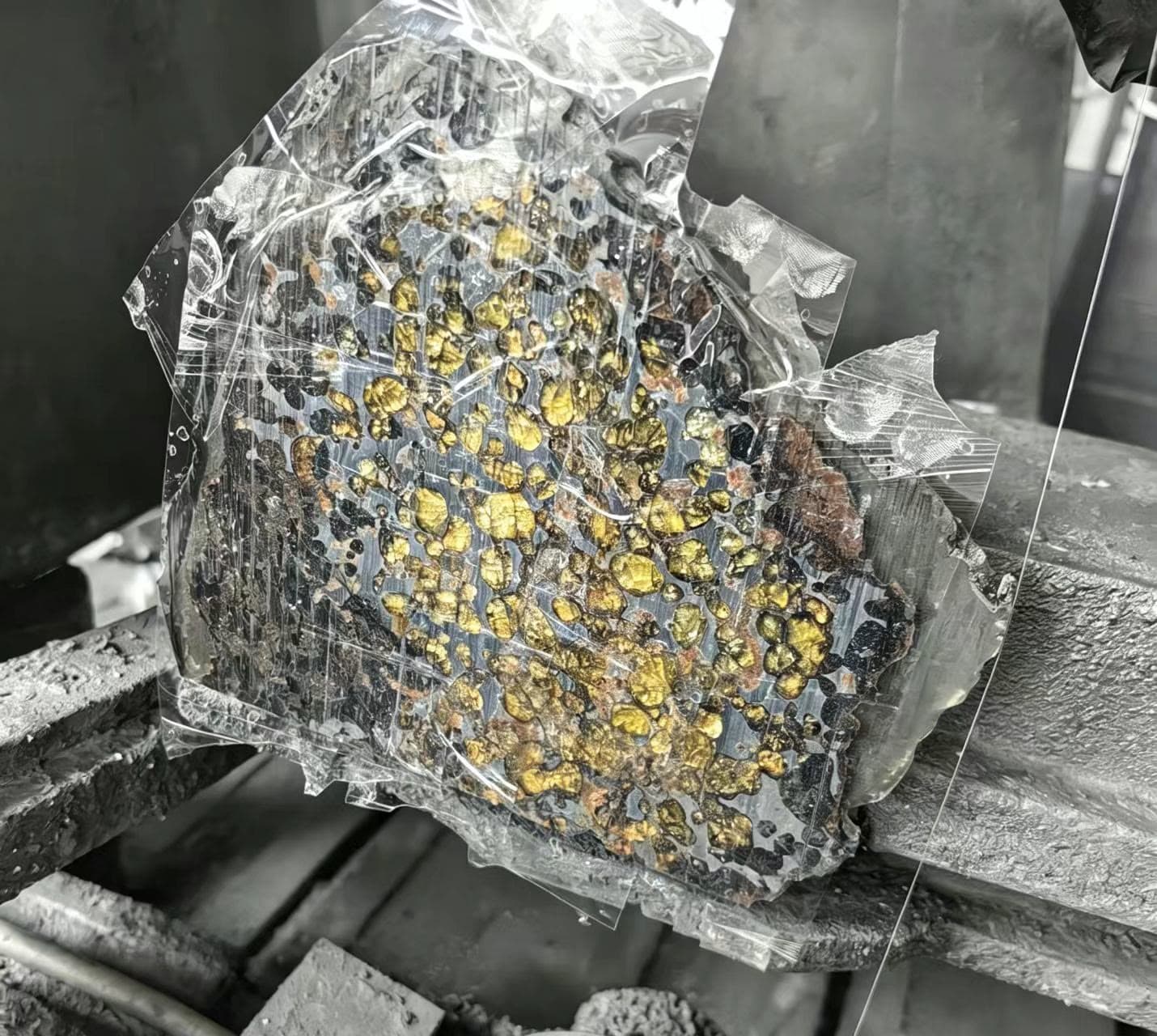
Pallasites — gem in metal
A pallasite is the showpiece of the stony-iron family: translucent olivine crystals — the same mineral as peridot, the August birthstone — suspended in a nickel-iron matrix. They are thought to form at the boundary between an asteroid’s metal core and rocky mantle, which is why a slice is often described as holding the core of a dead planet. Dive deeper in the pallasite guide, and meet two famous ones: Sericho (Kenya) and Seymchan (Siberia).
Mesosiderites — shattered and welded
The other kind of stony-iron is the mesosiderite — and it could hardly be more different. Instead of clean crystals in metal, a mesosiderite is a breccia: a chaotic jumble of broken metal and rock fragments welded back together, most likely by a violent collision between two asteroids. They are rarer and less showy than pallasites, but scientifically fascinating as a record of cosmic smash-ups.
How to recognise one
- Metal and rock together — a cut face shows bright metal and darker mineral in one stone.
- Heavy and magnetic — the metal content makes it dense and responsive to a magnet.
- Pallasite: rounded green/amber olivine crystals set in a shiny metal mesh.
- Mesosiderite: an irregular, broken-up mix with no clean crystals.
As always, provenance and testing confirm it — see how to tell if a meteorite is real.
Why stony-irons make stunning jewelry
Because a pallasite combines gemstone and metal in one natural material, it needs no added stone — the crystal is the jewel. Set as a ring, pendant or slice, and backlit so the olivine glows, a stony-iron is unlike anything else you can wear — and every piece is one of a kind.

Frequently asked questions
- A stony-iron meteorite is a meteorite made of roughly equal parts metal and rock — a mix of nickel-iron and silicate minerals. It is the rarest of the three main meteorite types. There are two kinds: pallasites, where gem-quality olivine crystals sit in a metal matrix, and mesosiderites, a jumbled breccia of metal and rock fragments.